STUDENT PROJECT
An App for
Creative Connection
Role: Concept & Product Designer
Team: Solo Personal Project for AcademyXi
Timeline: 3 months
Responsibilities:
All (including: User Research • Problem Definition • Ideation • Persona & Journey Map Creation • Wireframing • Prototyping • Usability Testing)
Chapters:
Research | Customer Journey Map | Ideation | User Flow & Wireframing | Style Guide
Project Expectation
Develop a personal project to learn the entire UX/UI design process. Identify a problem, conduct user research and synthesise the data to assess its significance and viability.
Ideate solutions, develop them into wireframes and create a high-fidelity prototype, conducting comprehensive user testing.
Project Reality
Undertaking my first UX/UI project with Academy Xi was a significant learning experience. Due to the nature of the flexible learning, this project was completed in a part-time capacity and, at times, maintaining momentum proved challenging due to life and work interruptions. We chose our own projects, and naturally, most of us selected issues close to our own interests. As you will discover, this sometimes made it challenging to shake off personal biases. Nonetheless, this initial project provided a strong foundation, and I am proud of these efforts. There’s plenty of room for improvement, but for now, let’s revisit the first steps of this budding product designer.
Research | Customer Journey Map| Ideation | Userflow | Style Guide | Prototype
The Idea
There’s a survey that reports that “the creative arts industry has the highest rate of imposter syndrome, across all sectors, affecting nearly 87% of respondents.”
Couple this with the fact that “81% of Australian artists work as a freelancer or on a self-employed basis” and it makes me wonder how creatives find the resolve to keep creating.
Most wrestle with self-doubt… yet must serve as their own cheerleader. Meanwhile, being told they’re replaceable.
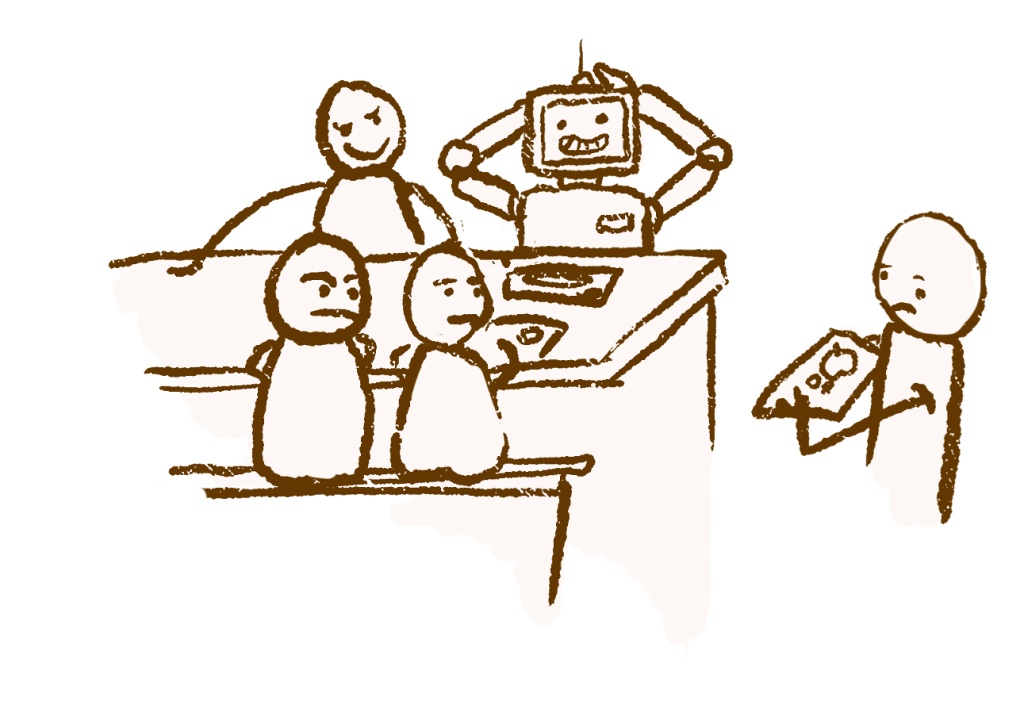
“What a colossal waste of time!”
This creative self-doubt is not an unfamiliar feeling. It has travelled with me through most of my twenties, appearing early on when I abandoned my Visual Merchandising ambitions for a ‘sensible’ payroll job. Until recently, I’ve spent most of my life as the only ‘creative’ in my friendship circle. Without peers who share similar dreams in a world that seldom values creativity as much as other skills, I’ve often wished I had talents considered more ‘useful’ to society. This has never prevented me from creating, but it has always been for personal hobbies. Even in these pursuits, there have been many times when I’ve looked around my social network and lamented the lack of fellow creatives.
Don’t get me wrong, I’d never rebuff the pleasant yet vague praise of the mildly interested friend or family member, but when you’re 13hrs deep and your creation resembles the art of a 5-year-old… that’s when I’ve deeply wish for the camaraderie of fellow creatives.
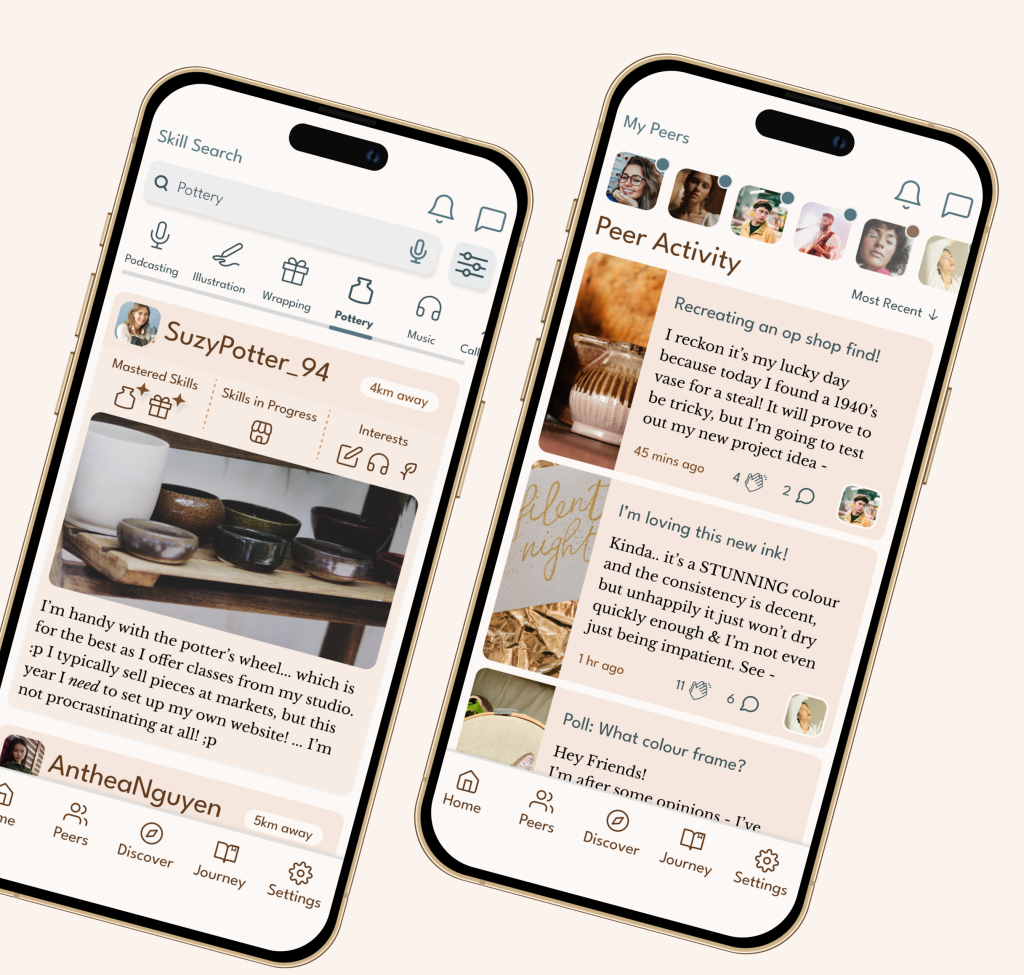
The concept I was toying with was an app that enabled users to engage and communicate with fellow creatives in their local area. A way to discover friends for deep conversations about the inspiration and process behind our creations, peers to troubleshoot with, and companions for company as we worked on independent projects. Most of all, I just wanted to believe that creativity was a blessing, not the curse I sometimes felt it was. I wanted to find out whether regular encouragement and collaboration between creatives helps motivate individuals to stick at their pursuits for longer?
Was it just me, or were others looking for kindred spirits?
Research | Customer Journey Map| Ideation | Userflow | Style Guide | Prototype
Research & Synthesis
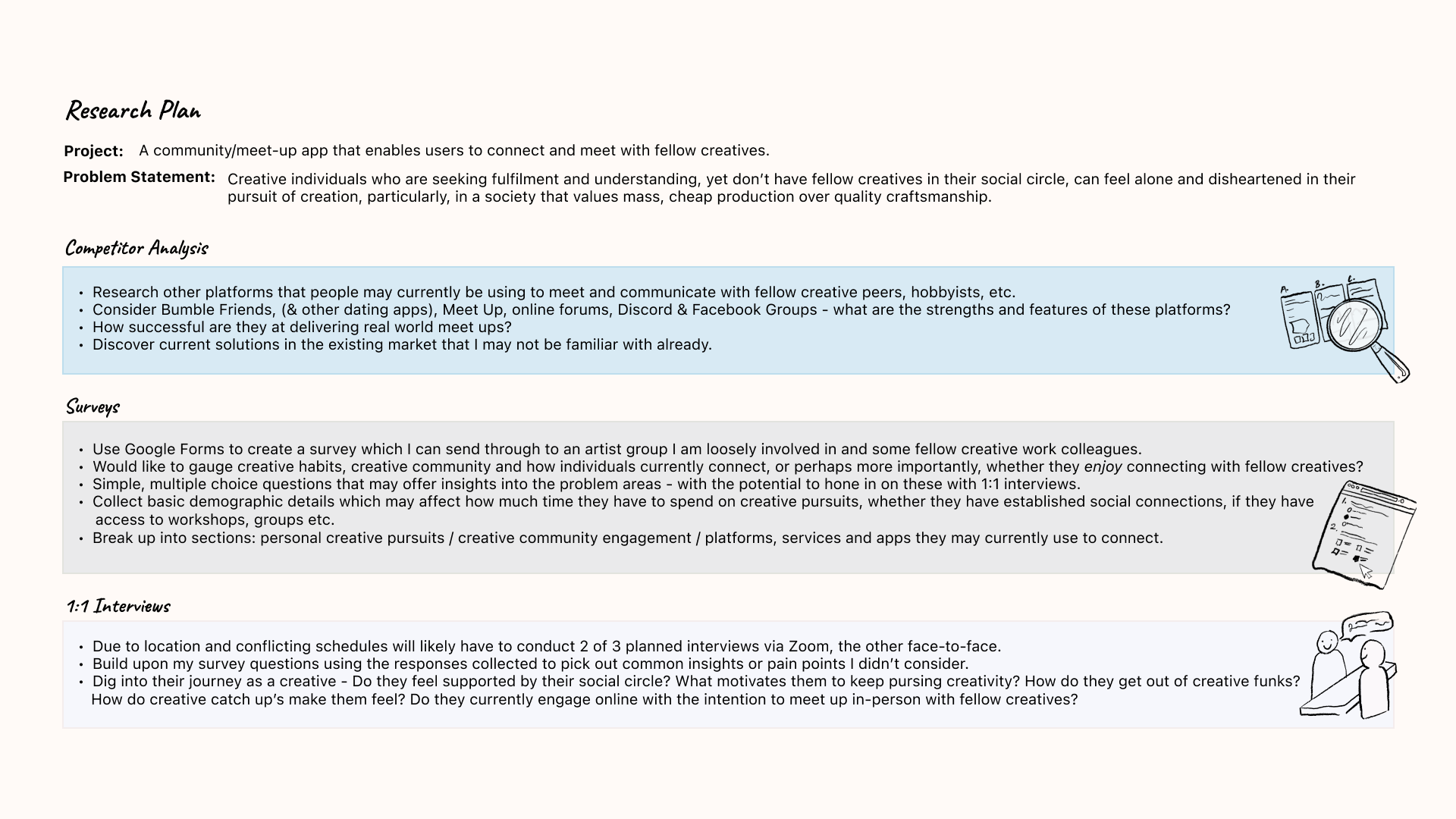
I started with a twenty-question survey exploring participants’ creative identities, motivations, barriers and the value they place on creative connections through personal relationships and social media. I received twelve responses, primarily from acquaintances who were members of an art collective Facebook group.
As the feedback came in, I identified questions I had overlooked or wanted to explore further. This input allowed me to adjust my interview questions for three one-on-one interviews.
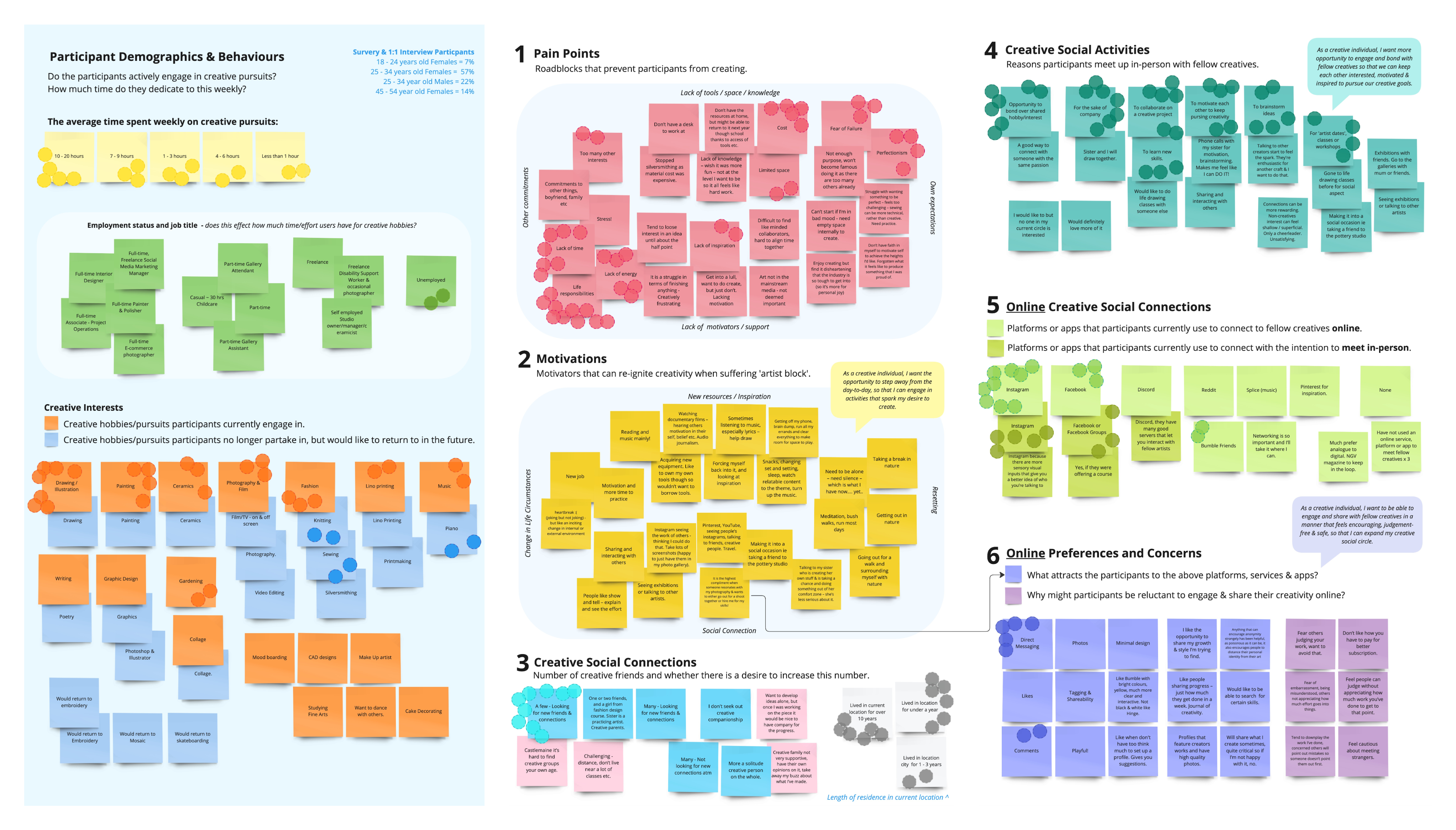
Limitation: Despite approaching a pretty even split, 87% of those who chose to partake in the research were female. 80% of which were in the 25 – 34 age bracket.
“Non-creatives are only cheerleaders”
Pooling the fifteen responses together gave me, as a novice, plenty to chew over. Whilst conversational nature of the one-on-one interviews provided more depth, I admit it was challenging not to read additional information into the responses of those I knew personally. This had been the stage I had most looked forward to, yet it took significant working and re-working to feel I had a good grip on the data.
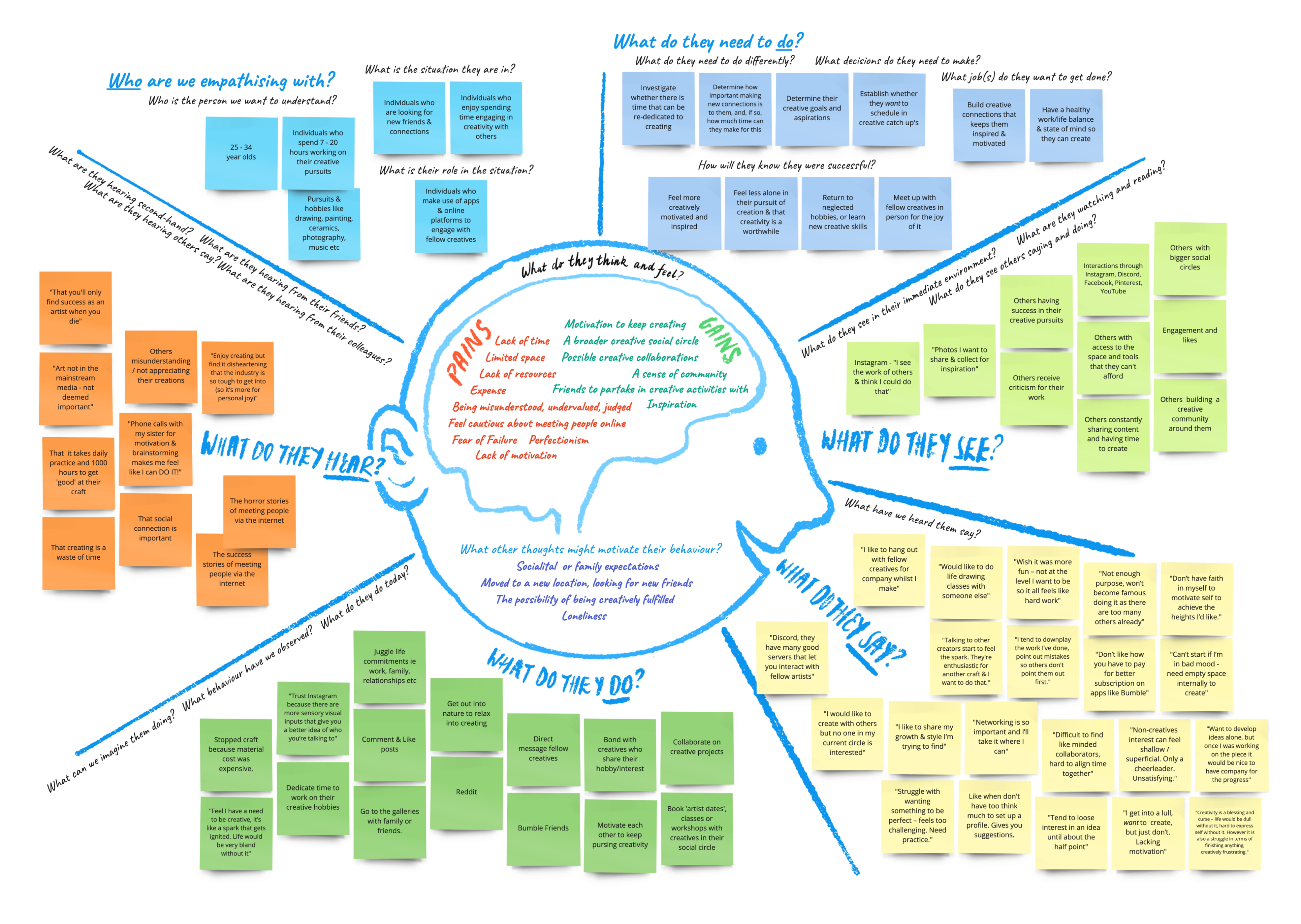
Although perhaps less popular in practice, I found the empathy map most useful as it allowed me to view the responses from a different perspective, thinking more from a user’s point of view.
Learning Reflections: Data Bias
Particularly since we were tasked with finding our own interview participants, I often wondered how much this exercise would improve as a team effort. As I transitioned into client projects, it became evident that it made a significant difference. It was easier to challenge my own biases when multiple interpretations of a response were considered.
This wariness of personal bias also greatened my appreciation for the art of question writing. It took me two days to craft my questions, aiming to balance specificity and vagueness to ensure answers were useful without leading participants to predetermined conclusions. It proved interesting to reflect over which questions yielded the most valuable insights and where questions fell short, providing little useful data due to lack of follow-up questions for context, such as job title. These gaps felt particularly prone to interpretation, making it tempting to read additional detail into the responses.
Creativity Roadblocks
“Fear of judgment; non-creatives won’t appreciate how much effort goes into it”
“I downplay the work I’ve done & point out mistakes, so, others don’t first”
“Need to get off my phone, brain dump, run all my errands & clear everything to create”
“Don’t have my own desk to work at” “Material cost was too expensive”
Creativity Motivators
“Calls with my friends for motivation makes me feel like I can DO IT!”
“I develop ideas alone, but once I am working on a piece, it’d be nice to have company”
“Talking to other creatives, start to feel a spark. They’re enthusiastic for their craft”
“Use IG to look at the work of others, think I could do that! Take lots of screenshots”
“I like to share my growth & style I’m trying to find”
Social Connection
“Would like to try life drawing classes, but none of my friends are interested ”
“Networking is so important and I’ll take it where I can”
Findings
The research both confirmed and challenged some of my assumptions, revealing aspects I hadn’t considered. As someone who has amassed almost too many art supplies over the years, I underestimated that many are deterred by cost and a lack of resources.
I had expected that individuals who had lived in their current area for more than four years would show less enthusiasm for making new friends. Yet, to my surprise, 87% of all participants expressed an interest in forming new connections, even though half of them had been residents of their current area for over a decade.
It was unsurprising, though, that lack of time emerged as a significant pain point. Addressing this challenge could be difficult, especially considering that building relationships requires time. The hole in my research was that I didn’t know how much downtime participants had available—whether they were genuinely occupied with life commitments or spending their leisure time on entertainment like Netflix or TikTok. I would compensate by ensuring there would be different levels of engagement users could commit; whether they wanted to actively contribute, simply appreciate content, or somewhere in between. My goal was to ensure that the app added significant value and fostered creativity as a meaningful way to spend time, aiming to improve confidence and social connections. This approach aimed to make it worthwhile, potentially achieving two goals at once.
Research | Customer Journey Map| Ideation | Userflow | Style Guide | Prototype
Persona & Customer Journey Map
*86% of participants would like to return to a creative hobby they no longer pursue.
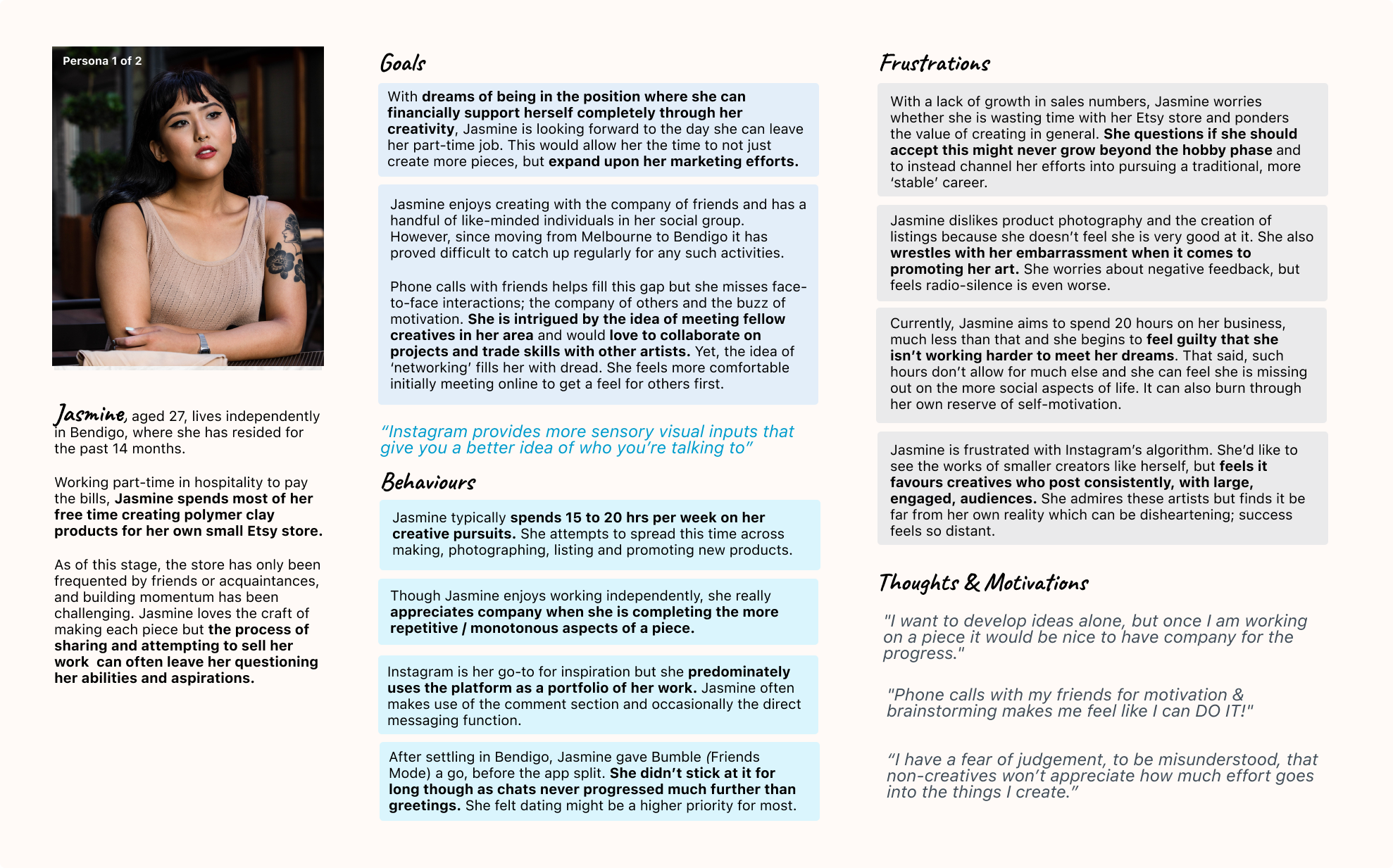
It felt necessary to divide my users into two personas: those with significant creative aspirations, dedicating 7-20 hours weekly to their creative endeavours, and those who preferred to maintain creativity as a hobby.
Persona 1 depicted individuals who most valued the input of fellow creatives for motivation and collaboration in their ongoing artistic pursuits.
Persona 2 encompassed those who sought to revive neglected creative hobbies* and expressed interest in acquiring new skills or creative experiences but struggled with limited time or resources.
Both personas were seeking to expand their social circle.
“How about… Tuesday? Nope?”
For each persona, I created a separate customer journey map. Since I was able to actually step through the journey of ‘Jasmine’, let’s concentrate on persona 1.
Jasmine is still in the early days of her Etsy shop, she regularly wrestles with the fear of failure and the discomfort associated with promoting her work. The bond of shared creative interests with friends can help Jasmine overcome these hurdles, but as an ongoing solution, it is limited due to her small creative network.
Unable to find a local artist meet up in her area, Jasmine attempts to meet creative friends with the use of Bumble BFF. Her journey map captured the process of creating an account and navigating the matching process.
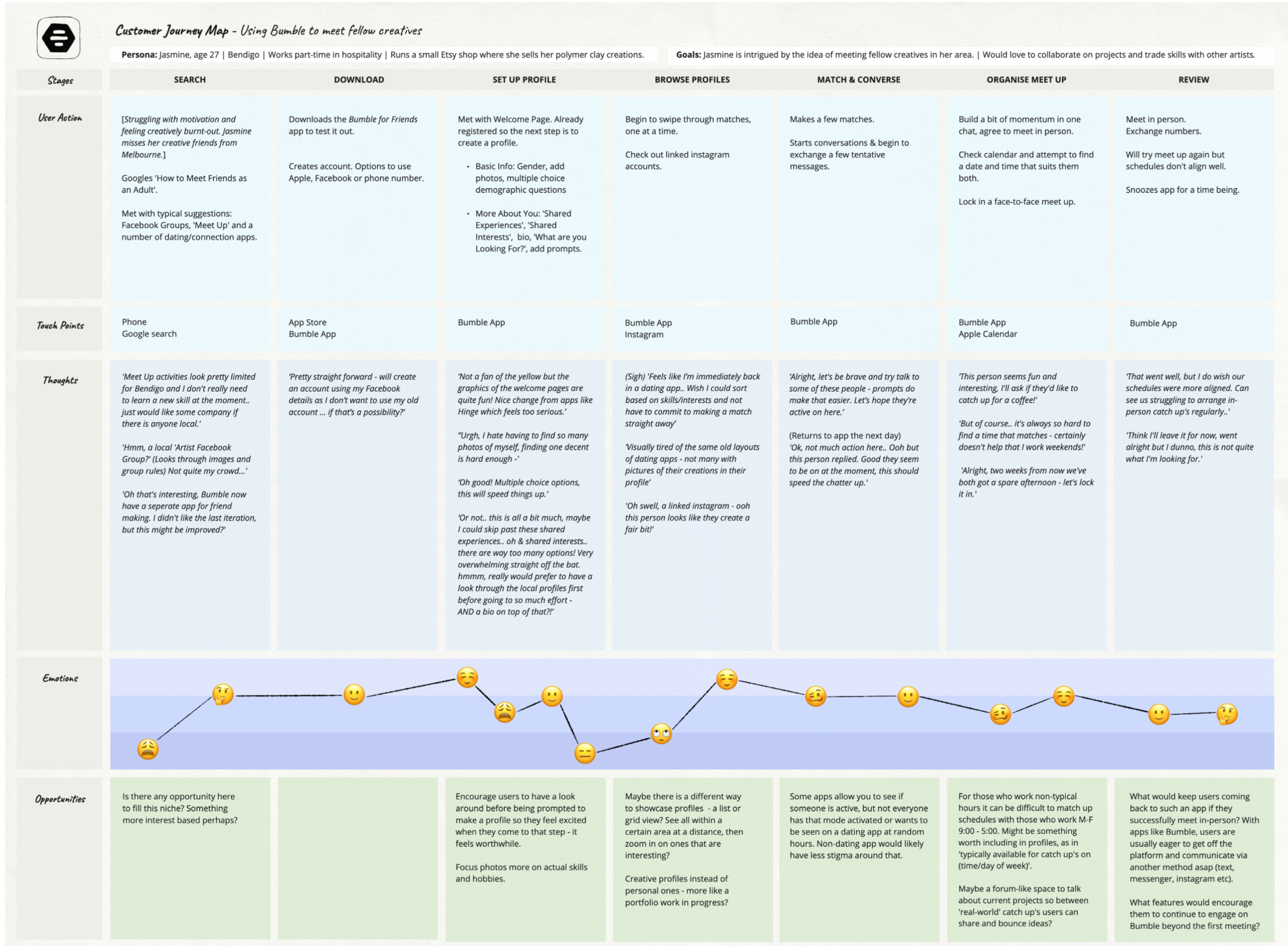
Bumble BFF Findings
Bumble BFF
- Profile creation was in-depth, but overwhelming straight off the bat. Couldn’t look around the app before investing the time in creating a profile, however, could skip sections and come back to them later
- Good multiple choice for profile creation and prompts
- Profiles are very similar to dating, not a positive connotation
- Despite making matches, aligning schedules proved a challenge
- Restricted by the inability to filter by availability
- Cannot see if fellow users are active
- No reason to come back to Bumble once you’ve made friends
Instagram (Alternative)
As I was unable to trial the process of meeting an individual via Instagram, I chose Bumble BFF for this journey. However, these are the Instagram reflections from the research participants, for design considerations.
- Good direct messaging
- Ability to comment builds connectivity
- Tagging and sharing works well
- Fear of negative comments and embarrassment
- User can be overwhelmed by content if follow numerous accounts
- Typically presents a very manicured version of creative process
- Can build communities but generally centred around one individual
Learning Reflections: Personal Restraints
I opted to explore the process of creating a Bumble BFF account because a small handful of participants had mentioned using this app for making new connections. However, given that 73% of my research participants were already active on Instagram, and 40% of them had successfully met fellow creatives through the app, based upon my own data, it would have been more beneficial to recreate this journey using Instagram.
Truth be told, I didn’t feel ballsy enough to attempt meeting someone new through Instagram in real life and my research was not sufficient to fully explore Instagram as an alternative option. It was easier for me to walk through the steps of creating a new profile with Bumble and draw upon my own experience for the conversations and meeting in person. Ideally, I would have preferred assigning this task to one of my initial research participants, but unfortunately, this wasn’t possible.
Nonetheless, this exercise still enabled me to identify opportunities that my potential app could address. However, in light of the app’s direction, I would thoroughly investigate Instagram as a competitor through the lens of my users before deciding on the app’s viability in the current market.
Research | Customer Journey Map| Ideation | Userflow | Style Guide | Prototype
How Might We’s & MVP
Having identified the key pain points, I formulated several “How Might We” (HMW) questions to guide the ideation phase.
HMW create a welcoming & encouraging connection point for creative individuals to engage with those with shared interests to enhance their sense of community and kinship.
HMW reduce shame and frustration around creative blockages or ‘failures’ in creative individuals so they feel comfortable to reach out to others for advice or encouragement when motivation takes a hit.
HMW reduce the barriers of creation for creative individuals who are limited by a lack of space or resources so they can sustain their creative hobbies or projects.
HMW connect creative individuals with shared or complimentary skills and corresponding availabilities, to reduce the barriers to organising in-person creative hang outs.
“Storyboarding… this just sounds silly”
With several HMW questions, naturally, ideas abound, so I filtered my ideas into three-prongs. Features that either:
- Supported users who sought encouragement
- Nurtured expansion of creative networks
- Promoted skill recognition through collaboration
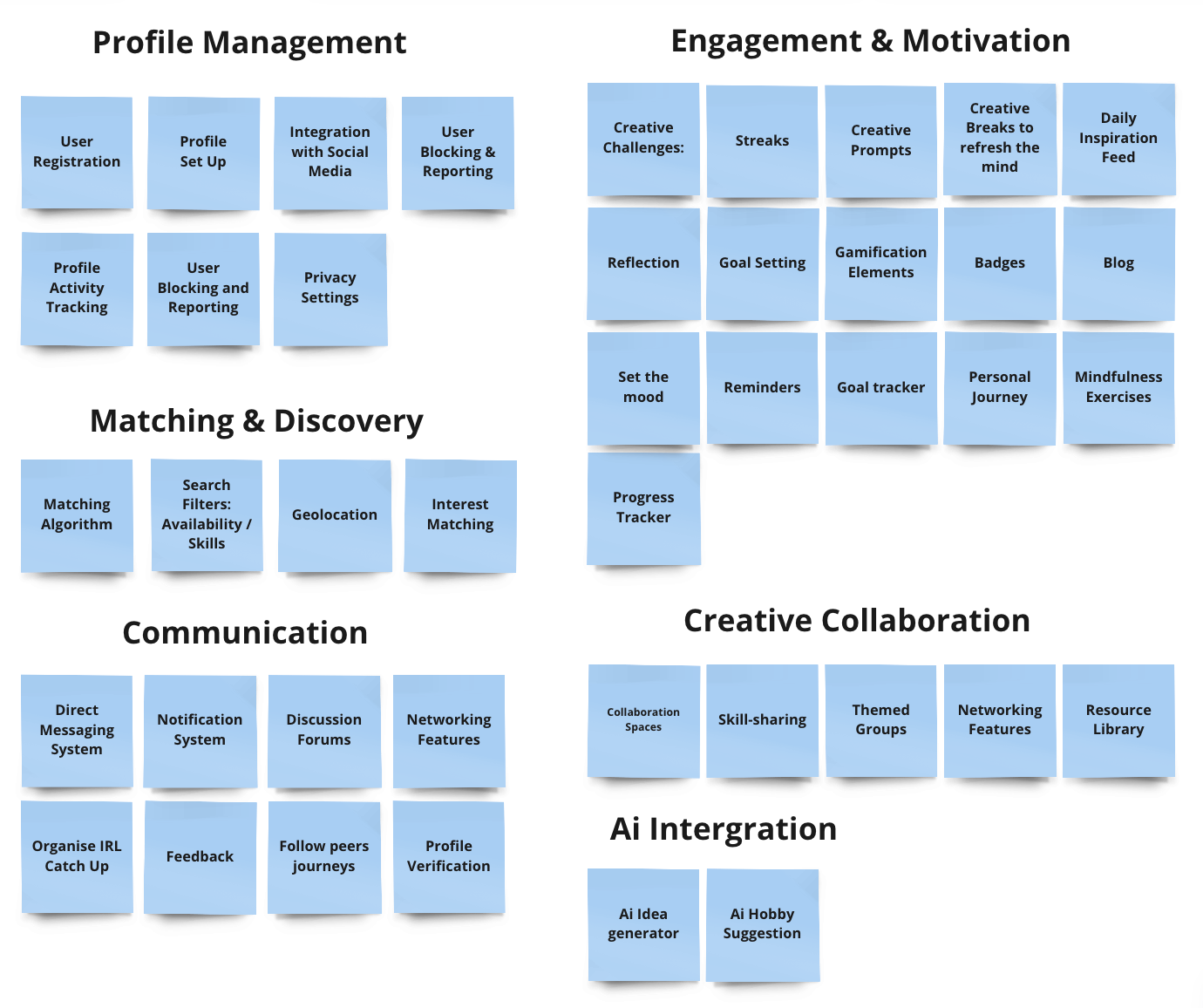
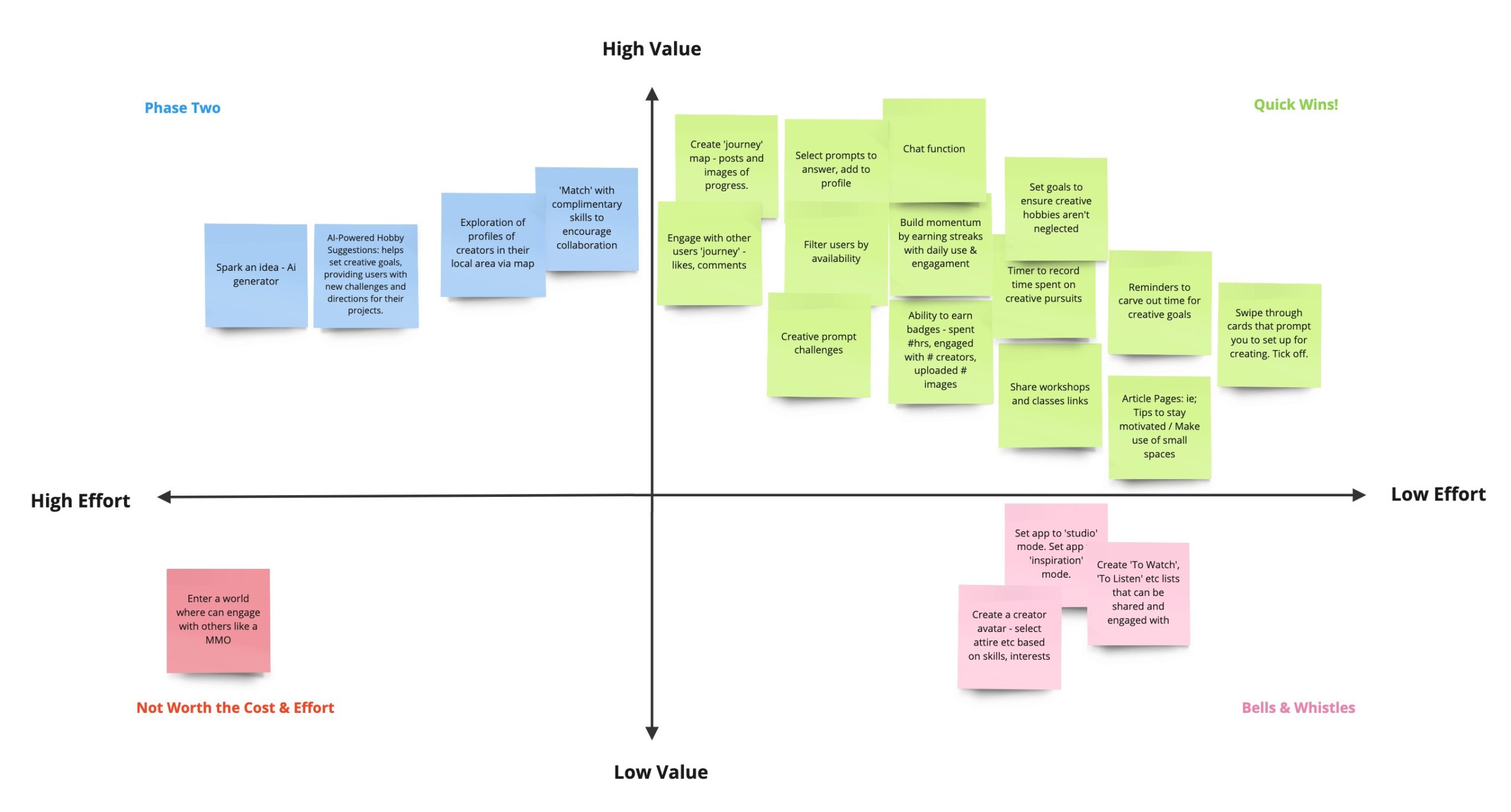
If they didn’t serve these needs, they were binned, or saved for future development.
Learning Reflections: Beneficial or just box-ticking?
Both the exercises of MVP and storyboarding had me questioning their validity at the time. The former clearly would add much value to a real-world project, but as a student, especially one with little web development experience, I didn’t feel confident in the credibility of the MVP exercise.
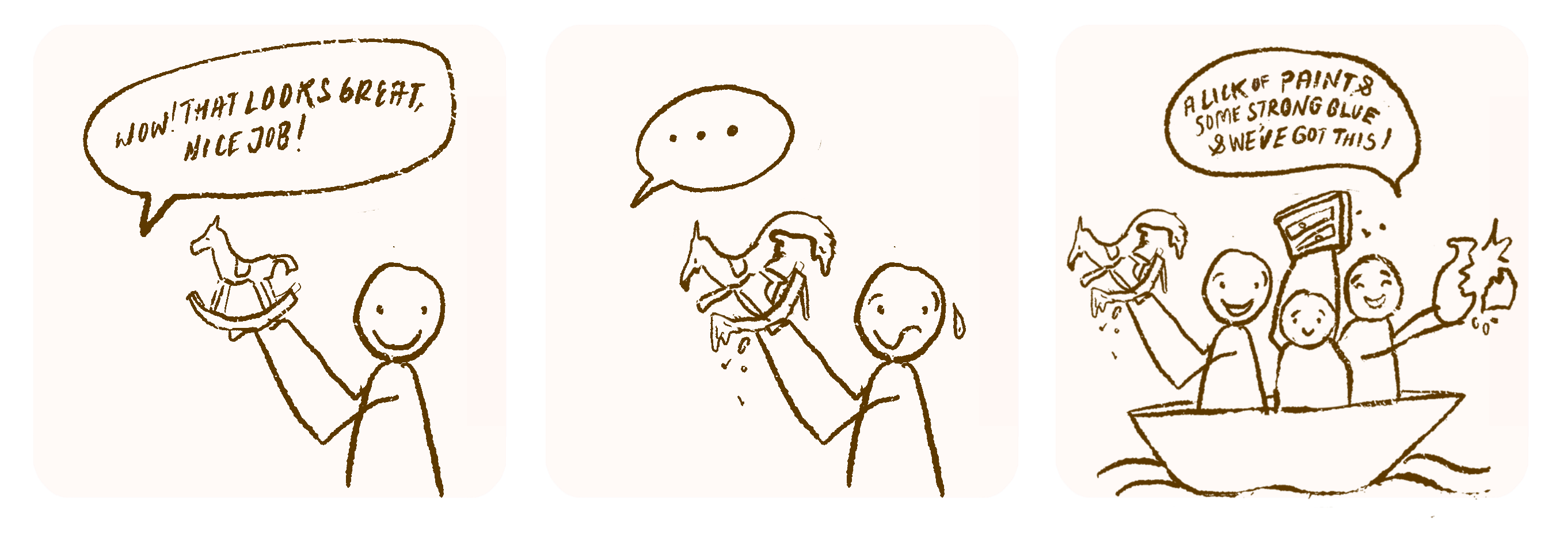
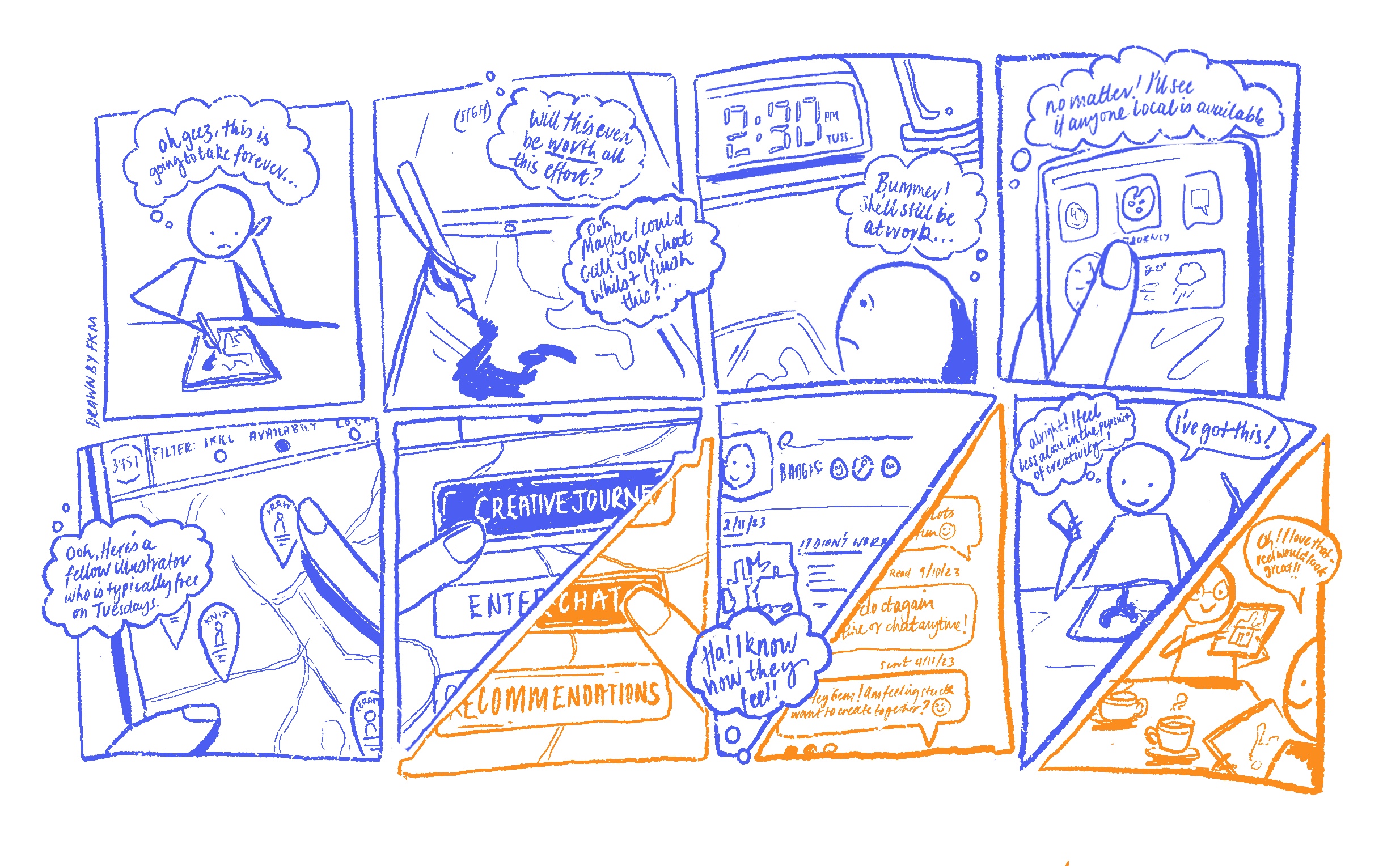
I admit, the concept of storyboarding felt childish and I procrastinated for quite a few days on this one. However, once I got started, and found my own style of comic illustration, it helped me capture the desired emotional impact of the app on users and its integration into their daily lives. I could see how it could serve as a simpler asset for quickly communicating this with stakeholders compared to the customer journey map.
Research | Customer Journey Map| Ideation | Userflow | Style Guide | Prototype
Userflow & Wireframes
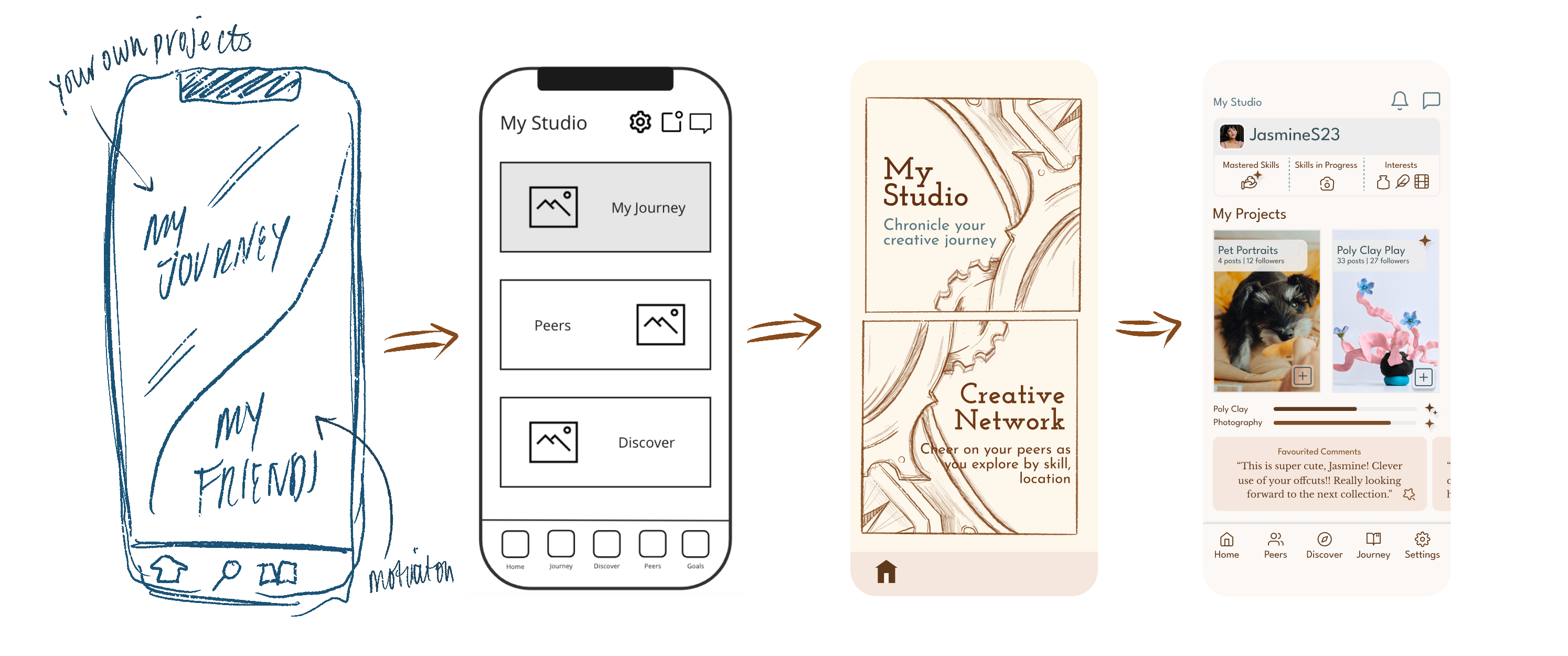
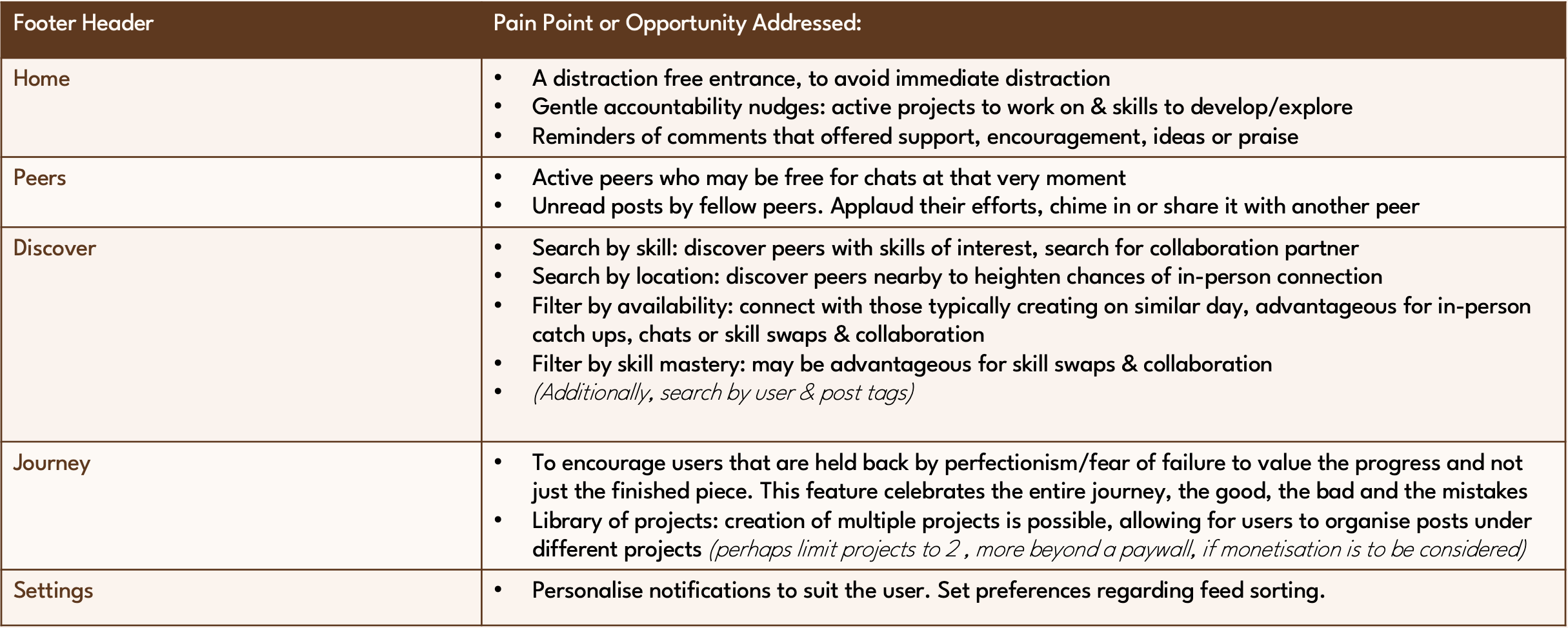
With a list of core features and functionalities, along with the emotional needs they addressed, I developed a cohesive user flow.
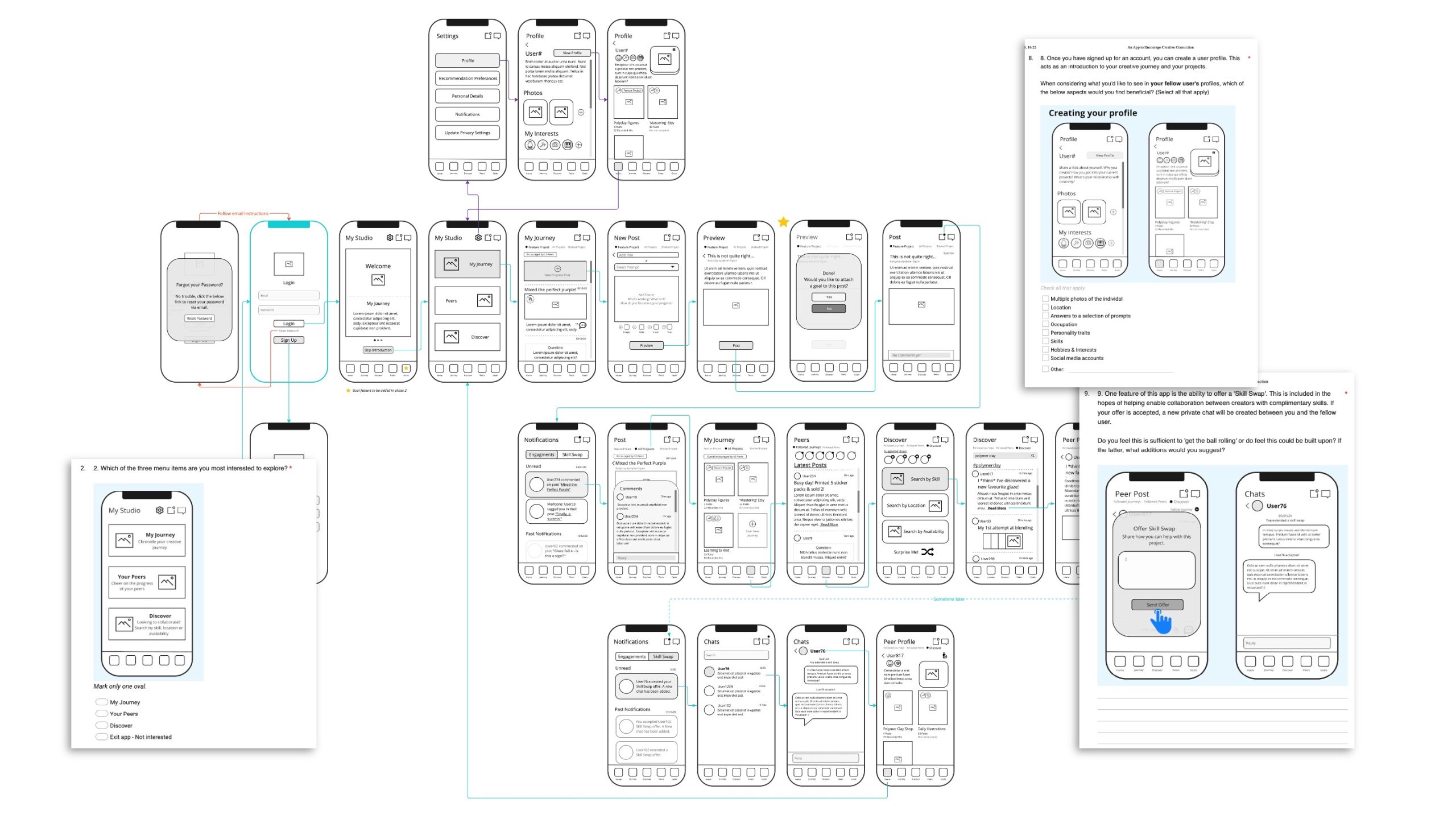
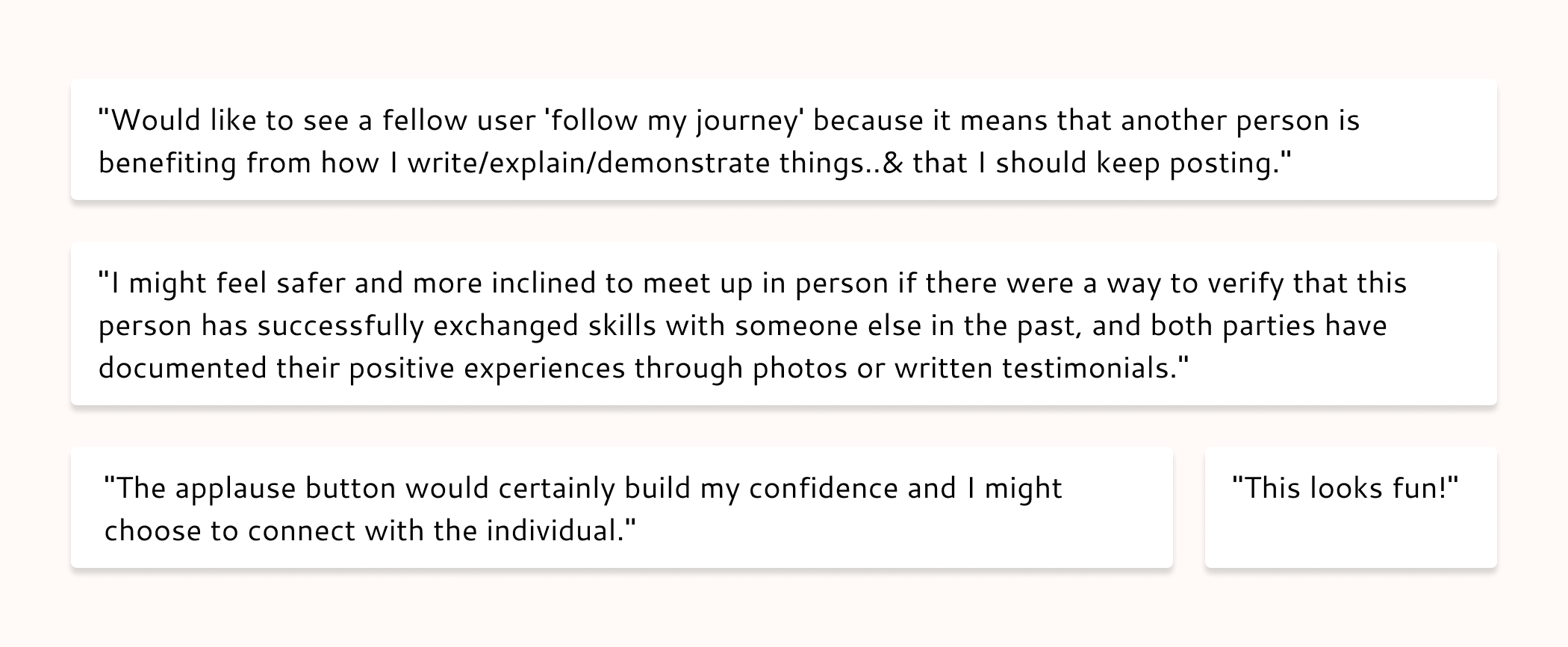
This blueprint served as the foundation for creating wireframes, which I tested via survey with eleven out of my fifteen initial research participants. My goal was to gather feedback on which features they were most excited about and to determine if the overall flow felt intuitive and user-friendly.
“I’m looking forward to seeing it come to life!”
My intention was to break the app into three pieces to help myself narrow down the breadth and concentrate on the problems I felt I could currently solve.
HMW encourage users that are held back by perfectionism/fear of failure?
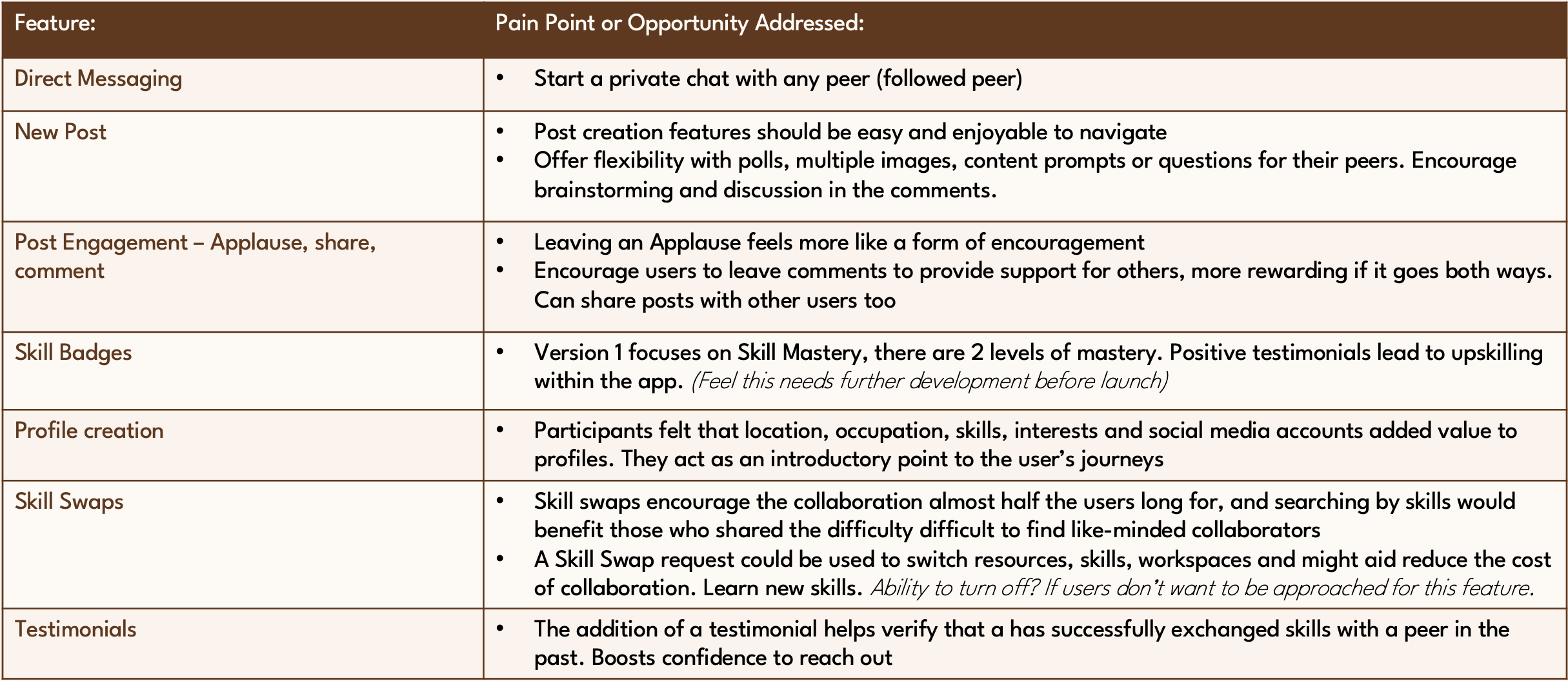
My Journey aimed to build encouragement by allowing individuals to share their creative progress with fellow users. This included seeking feedback, sharing insights, and discussing behind-the-scenes challenges. The goal was to help users value their progress, not just the finished piece; to celebrate the entire journey, the good, the bad, and the mistakes.
HMW create a welcoming & encouraging connection point for creative individuals?
Peers & Discover would allow users to support their fellow creatives in return. They can applaud their peers’ efforts, comment on posts, or share it with another peer who may be interested or could share advice. The ability to search by skill, location, or availability aimed to improve the chances of making meaningful creative connections.
HMW reduce the barriers of creation for creative individuals who are limited by resources, skills or lack of space?
Skill Swap addressed skill recognition by providing opportunities to collaborate, build confidence, and enhance profile credibility. Additionally, it could facilitate the exchange of resources, skills, and workspaces, potentially reducing the costs associated with creation or collaboration.
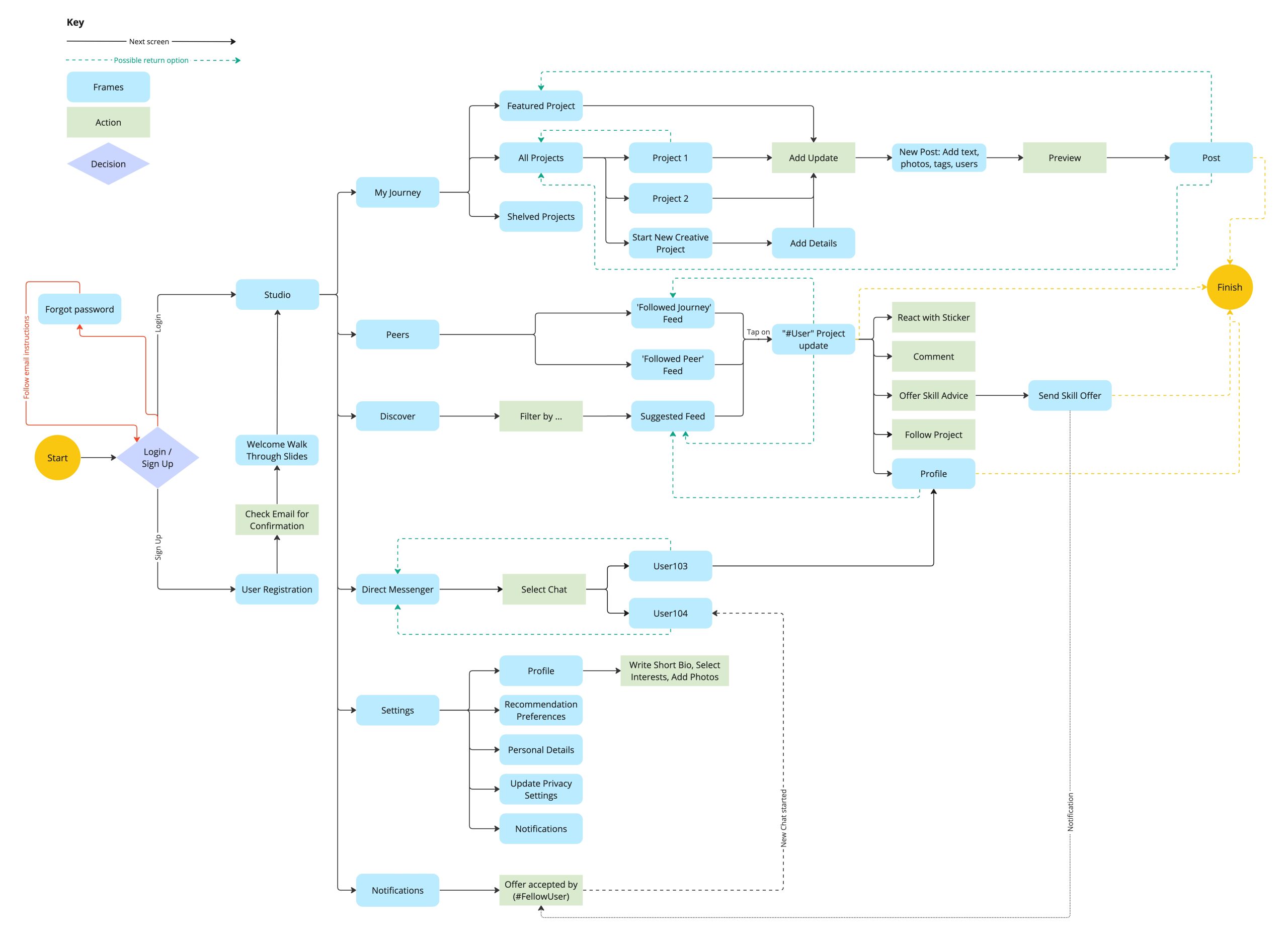
Both the user flow and wireframe underwent revisions after considering the results of my survey. My Journey was the section that 45% of users were most interested in exploring, so I decided to dedicate the home page to capturing one’s own progress. This approach ensured that users weren’t immediately distracted by fellow users’ posts as soon as they entered the app.
Additionally, 63% of users expressed a desire to search by skill. Therefore, the default search in Discover is by creative pursuit, with results organised by distance, which was also an important consideration for 70% of participants.
The survey provided me the first opportunity to reconnect with my research participants, and it proved a very useful tool and it proved to be a very useful tool for evaluating design decisions before I had invested too much time into developing the frames.
Research | Customer Journey Map| Ideation | Userflow | Style Guide | Prototype
Style Guide & User Testing
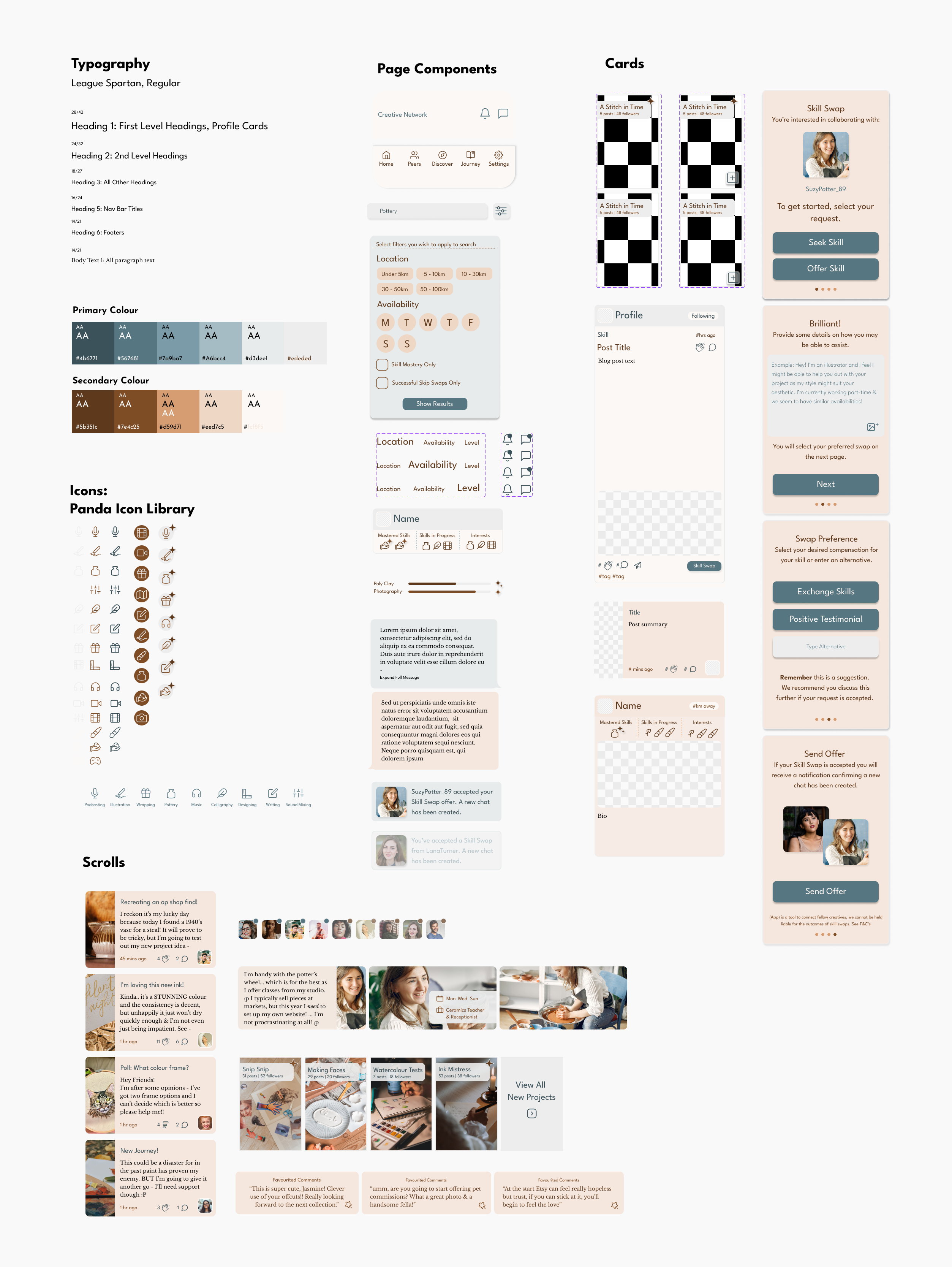
As I awaited the survey results, I contemplated the app’s aesthetic and created a style guide which I later built out into a small component library.
Considering the goal of the personal project was to serve as a stepping stone to the student-client projects, I focused on developing the frames that my survey pinpointed as most relevant and important in meeting my users’ requirements.
Developing the entire app would have demanded significantly more time than I had available, especially if I wanted to allow for user testing. Recognising the importance of this stage, I prioritised this step. As a result, I was able to conduct task testing for each of the three primary areas of focus.
“OH! I had no idea that was a button!”
For the apps design, I wished to create a calming space, reminiscent of a sketchbook, one which wouldn’t outshine the content being shared by users. Drawing inspiration from sailing ships, I chose a colour palette symbolising adventure and journeys.
I ensured that my colours and typography adhered to the Web Content Accessibility Guidelines AA standard, an exercise which provided valuable insights. (It also led to the realisation of how inaccessible my own personal blog was— a rather amusing discovery!)
Upon reaching a mid-fidelity level with my key frames, I proceeded to develop these with five users. For evaluation, I devised a series of tasks, rating the execution of each step on a scale of 1 to 5: where 1 indicated the user was entirely confused, and 5 signified no navigation issues whatsoever.
Here is an example of design improvements achieved through testing, through the example of the homepage:
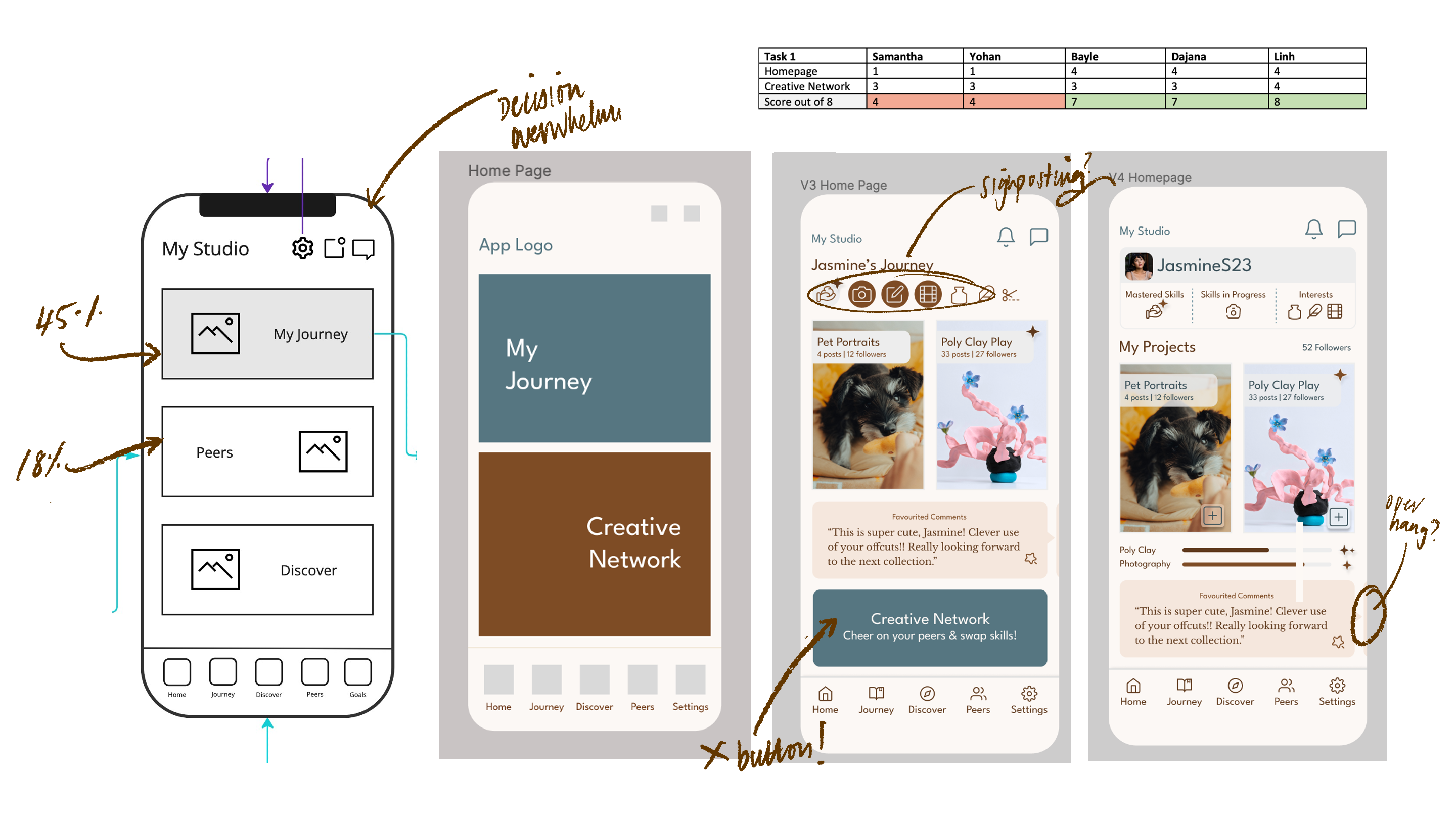
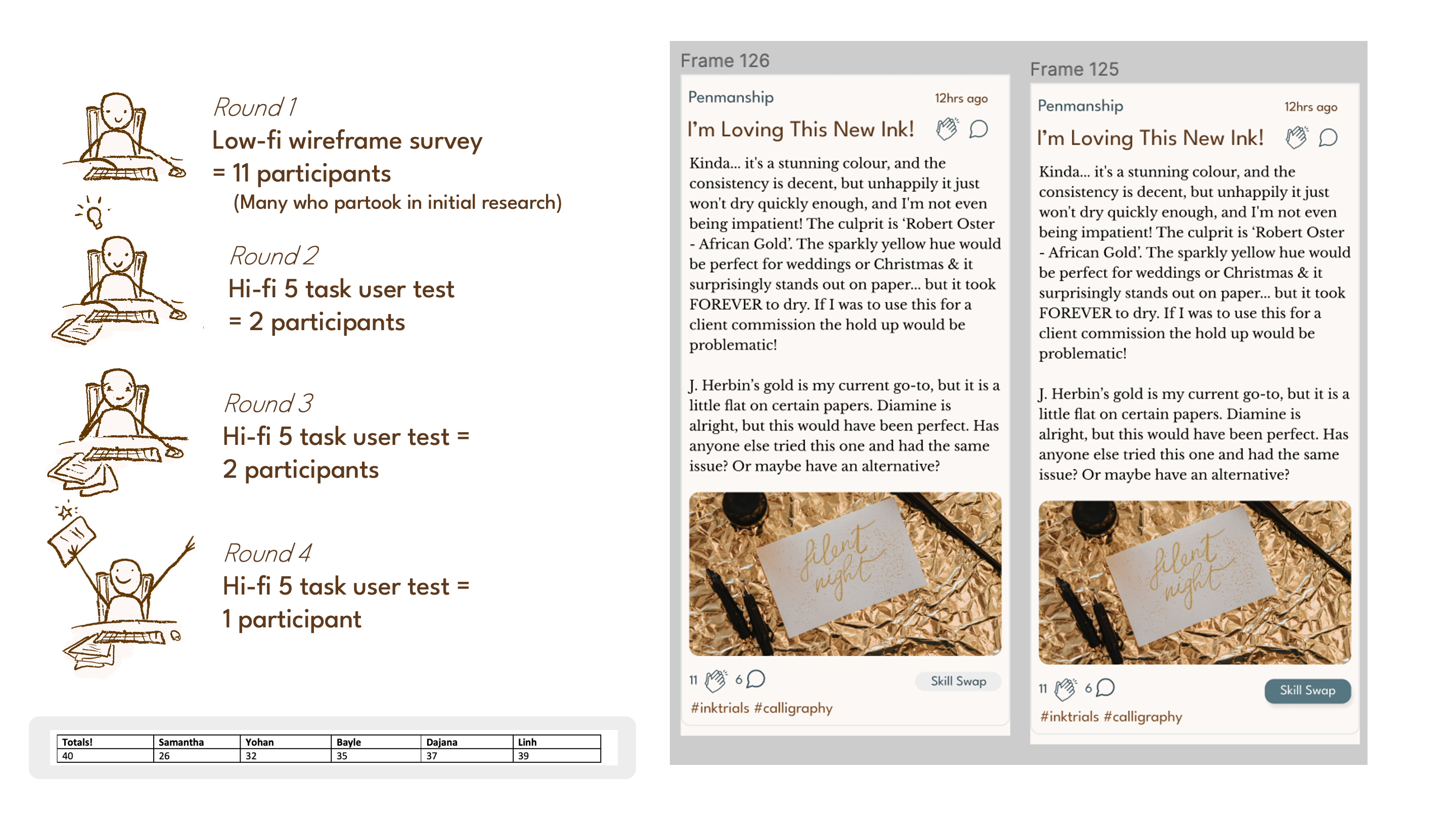
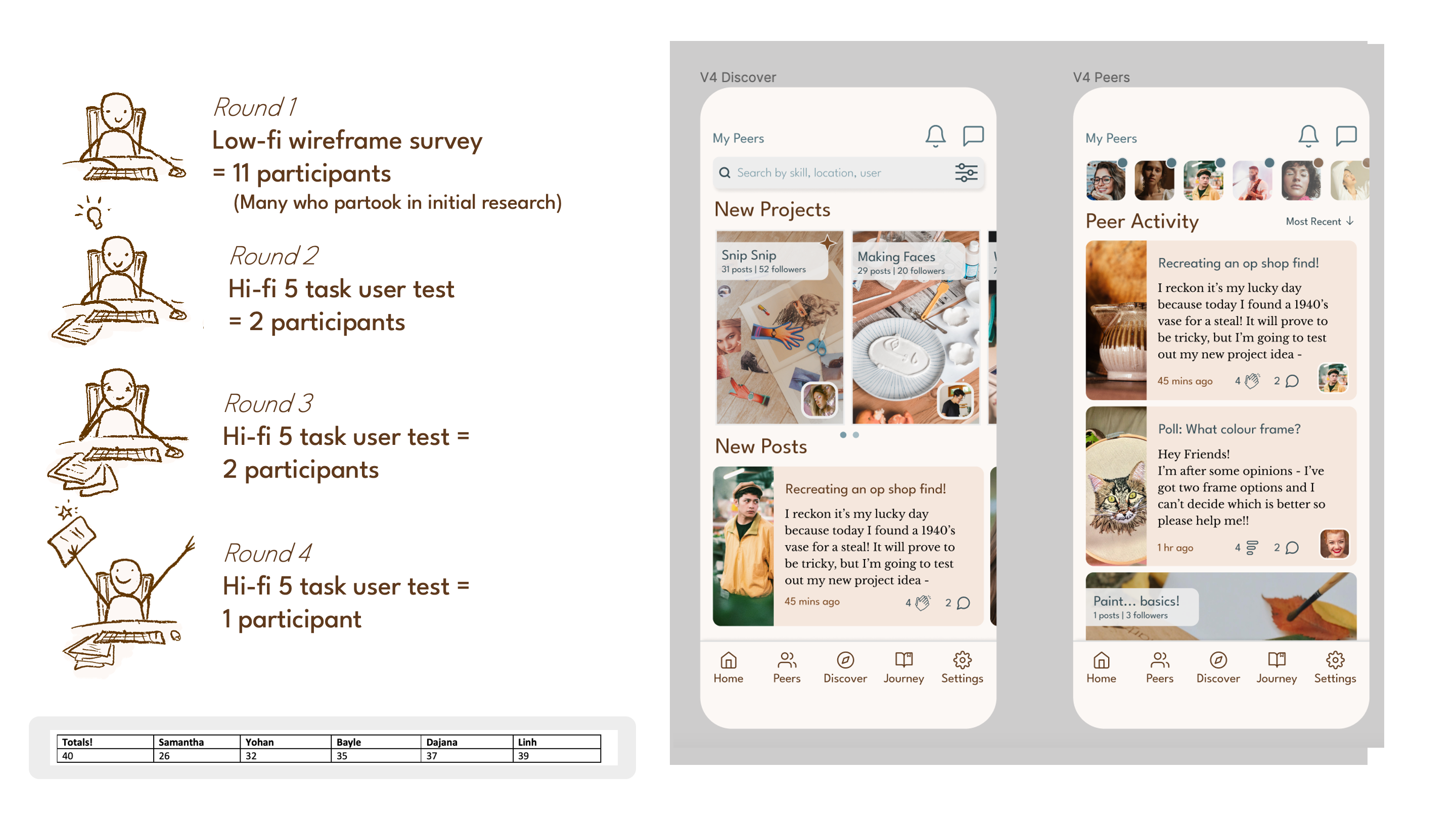
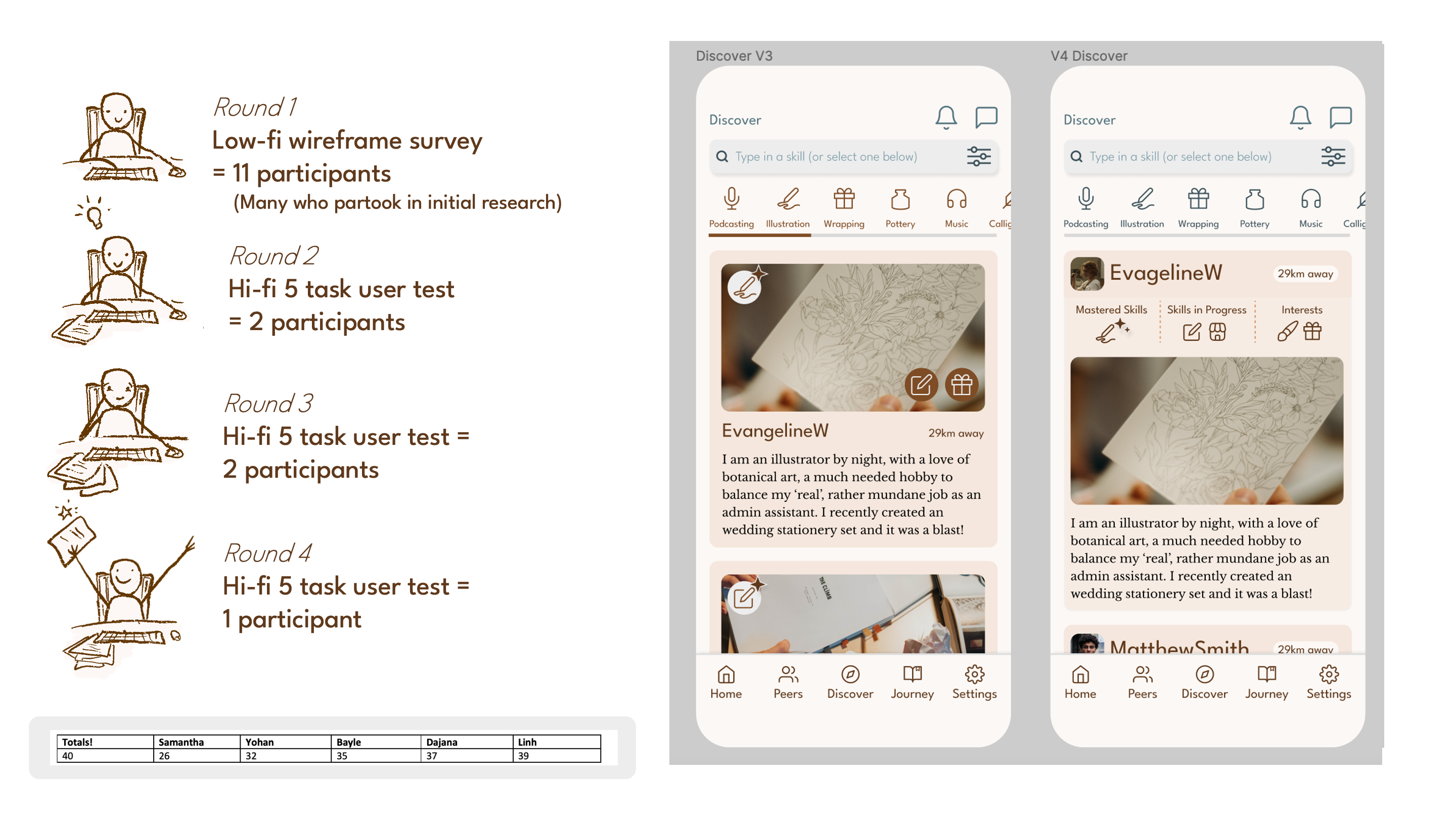
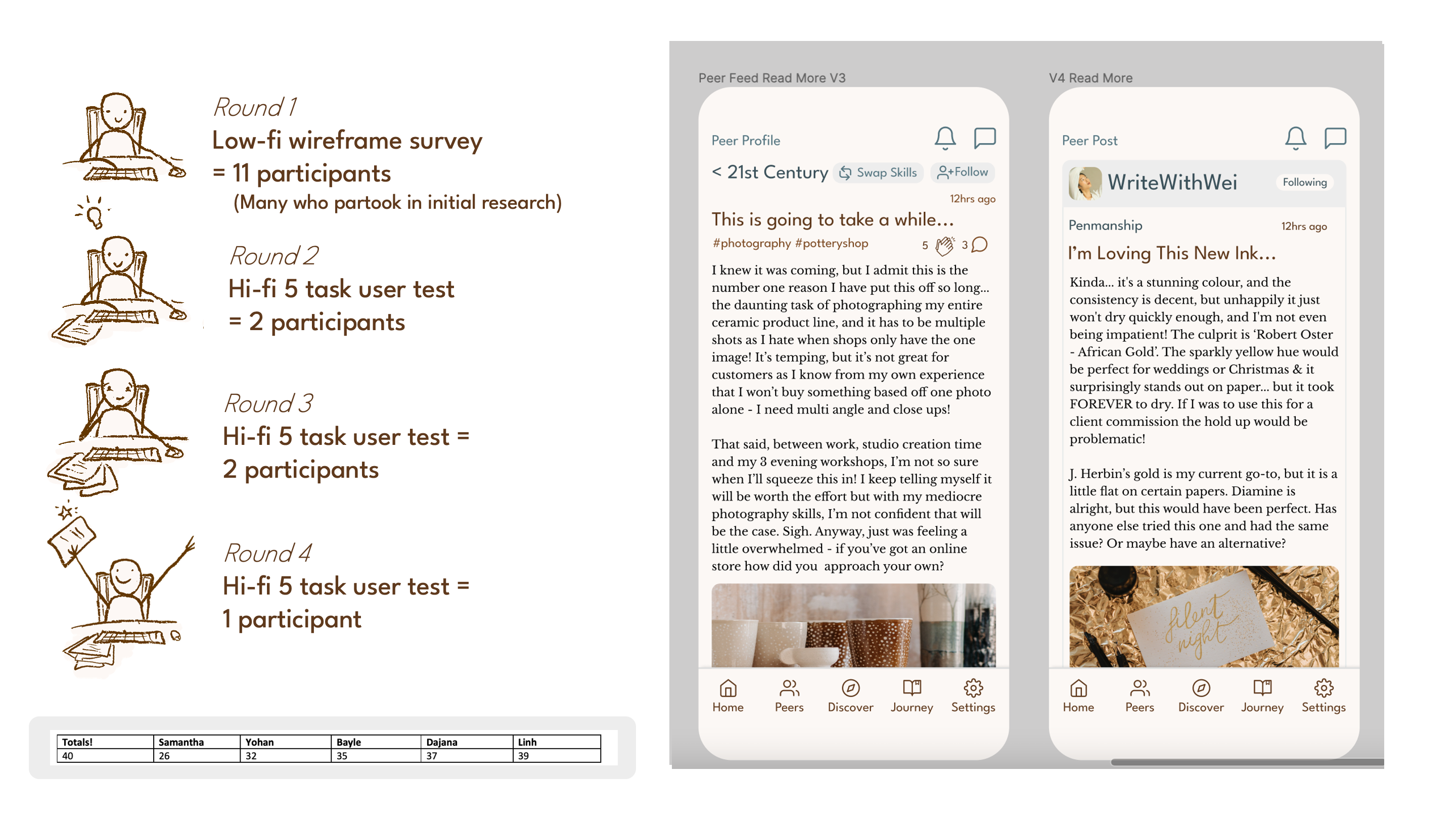
The adjustments were supported by an increase in testing scores. Other changes included the:
- Streamlining of headers
- The consistency of signposting
- A simplified post feed
- & improved clarity of small buttons
Research | Customer Journey Map| Ideation | Userflow | Style Guide | Prototype
Prototype
This leads us into the prototype:
You’ll be navigating the app as Jasmine; she’s had an account for a couple of months & is popping in to check on her peers and to perhaps connect with someone new.
Prototype V1
“What’s Next?”
Given the constraints of time allocated to this project, it’s important to note that the current prototype remains incomplete and would require further development and further testing to become a viable product. Additional features and refinements to be incorporated include:
- An introductory walkthrough of the app
- The creation of a new journey & new post
- Creation and edits to profiles
- Refinement of skill ‘levelling up’
- Settings including preferences & notifications
- Integration of social media accounts
Phase Two Additions
If the app went to market and was well received, there were a few additional features which may have some potential.
1. The ability to attach goals to journey projects
2. The addition of a pomodoro timer and some artistic warmup exercise to set the intention of creating
3. Fleshing out badge incentives to encourage a wide range of app engagement
Conclusion
We can’t wind things up without addressing my initial question: does regular encouragement and collaboration between creatives help motivate individuals to stick at their pursuits?
Given my limited participant pool and, let’s be honest, amateur research, I hesitate to draw any definitive conclusions. However, it’s worth noting that since sharing this app concept with several individuals, there has been considerable interest in the idea. (Though it’s possible that they were just being polite…)
Overall, I believe there’s a nugget of potential in this project. While I may not have fully realised the concept yet, I would be interested in revisiting this project once I have a lot more experience under my belt.
Appendix
That was quite the journey! Thank you!
It’s one thing to create your own project, it’s quite another to work on a student client project…
Or wish to relive the journey?
Research | Customer Journey Map | Ideation | User Flow & Wireframing | Style Guide | Prototype